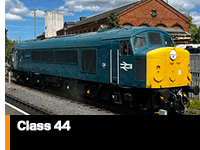
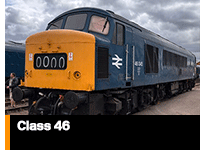
The Class 45 was the largest of the 3 "Peak" classes (the others being the prototype Class 44 and the follow-on Class 46 with different equipment) [1]. The Class 45s were the motive power mainstays of the Midland Main Line from the 1960s into the early 1980s. Like the other Peak classes, the Class 45s were powerful locomotives, though this power came at a price of high weight. Weighing in at over 130 tons, the Class 45s had to have 1Co-Co1 bogies with extra non-powered wheels to help spread the weight on the rail.

45 118 at Derby Litchurch Lane Works
| Information | |
|---|---|
| Number built: | 127 |
| Built: | 1960-62 |
| Builder: | BR Derby & Crewe |
| Engine: | Sulzer 12LDA28-B diesel |
| Power: | 2, 500 hp (1, 864 kW) |
| Wheel arrangement: | 1-Co-Co-1 |
Design wise, the Peaks shared some of their appearance with the LMS 10000 prototype diesel-electrics and North American practice with their bonnet noses - though the bonnets were noticably shorter like the English Electric Class 40. The large grills on the side of the locomotive were intended to try and produce a cleaner design and hide the many apertures that had appeared on earlier and contemporary locomotive designs [2].

Preserved and resplendant at Barrow Hill
The Class 45 consisted of two sub-types, the 45/0 with steam train heating and the 45/1 with electric train heating. The arrival of the High Speed Train in the 1980s displaced them from express work. though they continued on secondary passenger services and freights into the late 1980s. They were finally withdrawn by 1989, outlasting the other Peaks by a few years.

Another Class 45 at Barrow Hill, this one needs some repainting!
Eleven have been preserved, though not all currently are in working order.

45 118 and some fellow Peaks

45 041 at Princes Risborough

45 060 at Kidderminster Town
[1] Brian Haresnape, Production Diesel-Electrics Types 4 and 5 (Ian Allan, 1984) p. 31
[2] David Lawrence, British Rail Designed 1948-97 (Ian Allan, 2016) p. 116