The first of the "Peaks", the Class 44 was the most powerful of diesels built in the British Railways Modernisation Plan diesel pilot-scheme, but also the heaviest! [1] They were in the highest Type C power classification, later renamed Type 4. Weighing in at 133 tons (and that was with some modifications to reduce weight) the Class 44 were imposing locomotives with their 1Co-Co1 bogie wheel arrangement, which had extra load bearing wheels (similar to the Class 40 and the Bulleid prototype main line diesels). The Class 44 derived a lot of it's internals from the LMS prototypes 10000/1 and the SR Bulleid locomotives 10201-3.
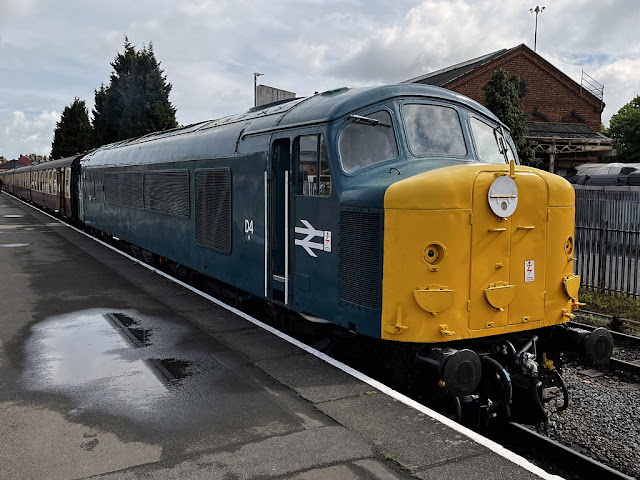
D4 at Kidderminster Town
| Information | |
|---|---|
| Number built: | 10 |
| Built: | 1959-60 |
| Builder: | British Railways Derby |
| Engine: | Sulzer 12LDA28 diesel |
| Power: | 2, 300 hp (1, 715 kW) |
| Wheel arrangement: | 1Co-Co1 |
Although there were some early issues with the bogies, which could crack or catch fire if maintenance was lax, the Class 44s were a successful design and were followed on by the uprated series production Class 45 and 46. All three classes of locomotives are known as the Peaks, the name due to the Class 44s being named after British mountains.

D8 at Rowsley South
When they first entered service they were used on express passenger services. They were supplanted by more powerful machines after a few years and spent most of their careers, especially on their final years, on freight duties in the London Midland Region area [2].
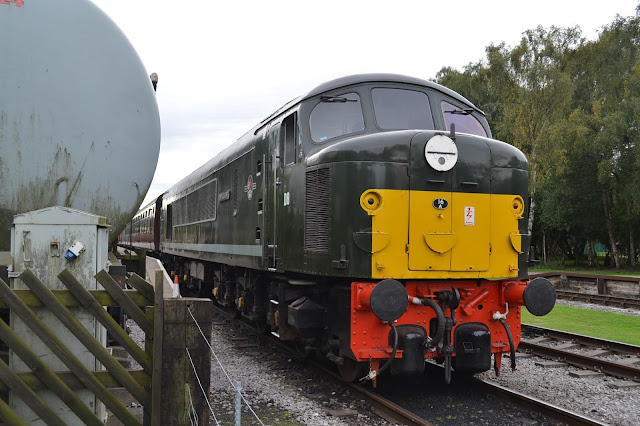
Another view of D8
Scrapping began in the late 1970s as the Class 44s were surplus to requirements, with the last leaving service in 1980 [3]. Two have been preserved.

D4 arrives at Kidderminster Town
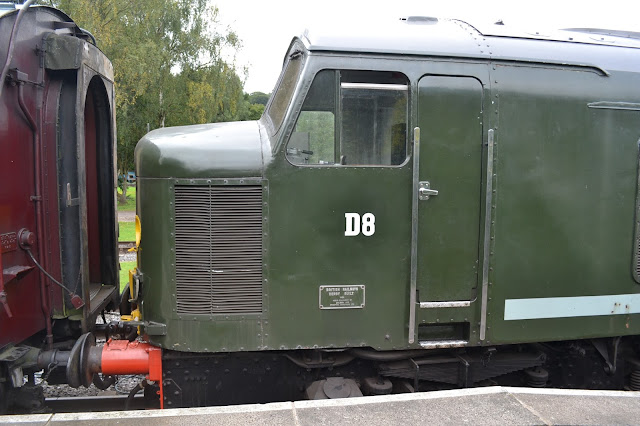
Nose view of D8

D8 stands ready for a new service
[1] Brian Haresnape, Early Prototype & Pilot Scheme Diesel-Electrics (Ian Allan, 1981) p. 77
[2] John Vaughan, Diesels on the London Midland (Ian Allan, 1981) p. 62
[3] John Glover, BR Diary 1978-1985 (Ian Allan, 1985) p. 47