
The Royal Navy's fleet of aircraft carriers was gradually drawn down in the 1960s and 1970s, along with the Fleet Air Arm's fixed wing carrier-based aviation. A new generation of smaller carriers (called through deck cruisers) was devised but would be too small to operate traditional catapult launched fighters. Instead, the Royal Navy turned to the Harrier vertical take off and landing aircraft to produce the Sea Harrier.
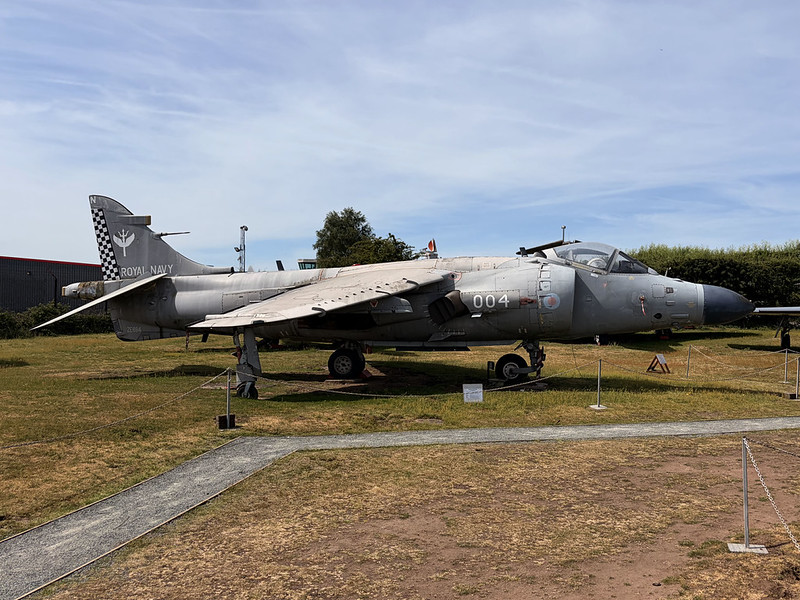
Sea Harrir FA2 at the Midland Air Museum
| Information | |
|---|---|
| Manufacturer: | British Aerospace |
| First flight: | 1978 |
| Propulsion: | Rolls-Royce Pegasus 106 vectored thrust turbofan |
| Withdrawn: | 2016 (Indian Navy) |
| Number built: | 98 |
The first testing with an aircraft of this type began way back in the 1960s. A Kestrel made a landing on HMS Ark Royal in 1963 though at the time the Fleet Air Arm had no need of such a type. This changed in the 1970s. The Sea Harrier FRS1 was introduced in 1978. It was able to make rolling take off from the new carriers. A ski-jump was also added to the carriers to aid with take-off.
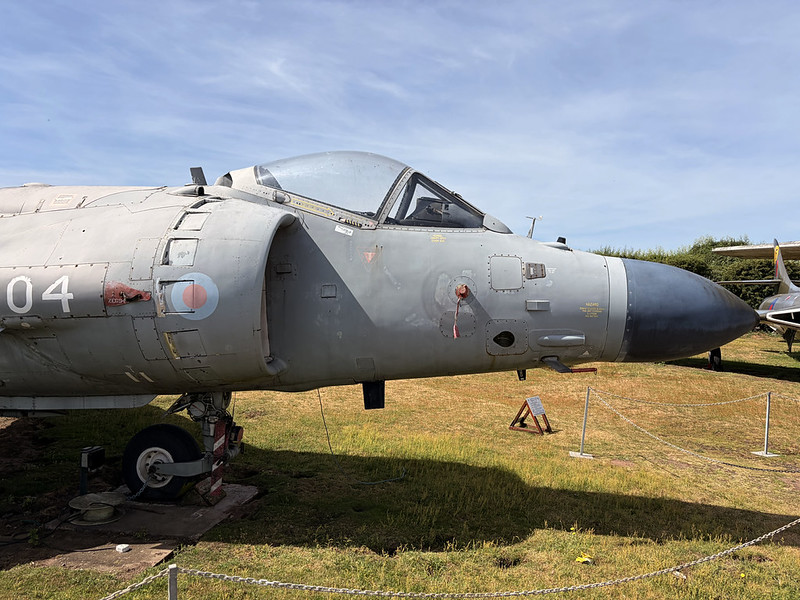
The Sea Harrier has a raised cockpit compared to earier Harriers
The Sea Harrier became operational in 1981 and within months it began to make it's name. During the Falklands War in 1982, the Sea Harrier proved itself a formiddable interceptor, shooting down twenty Argentinian warplanes without reply (two Sea Harriers were lost to ground fire). As well, the Sea Harriers, and RAF Harriers also embarked on the Royal Navy's pair of aircraft carriers, carried out an important ground attack role.
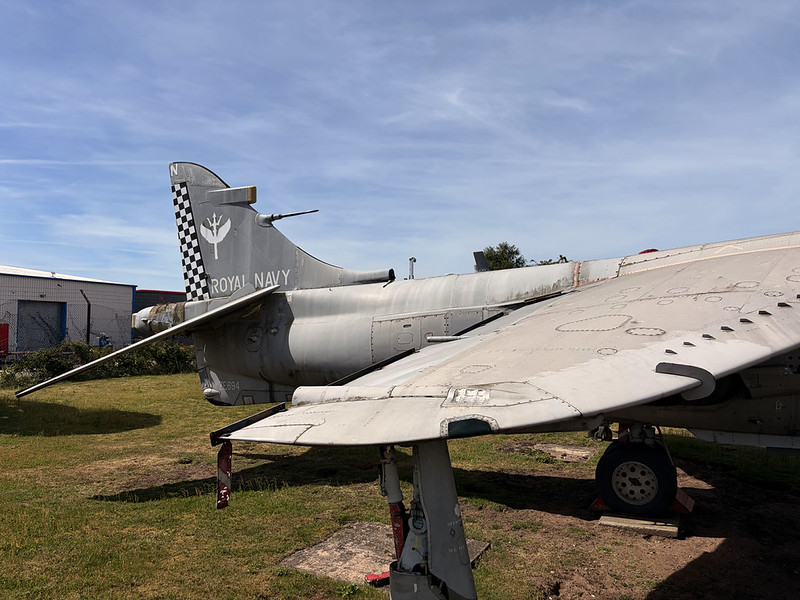
Tail showing it's Hawker Siddeley heritage
An improved FA2 model was developed in the late 1980s using experience gained from the Falklands War. The Sea Harrier was also sold to the Indian Navy. The Sea Harrier served with the Fleet Air Arm until 2006, also seeing action in the Balkans. India withdrew theirs in 2016.
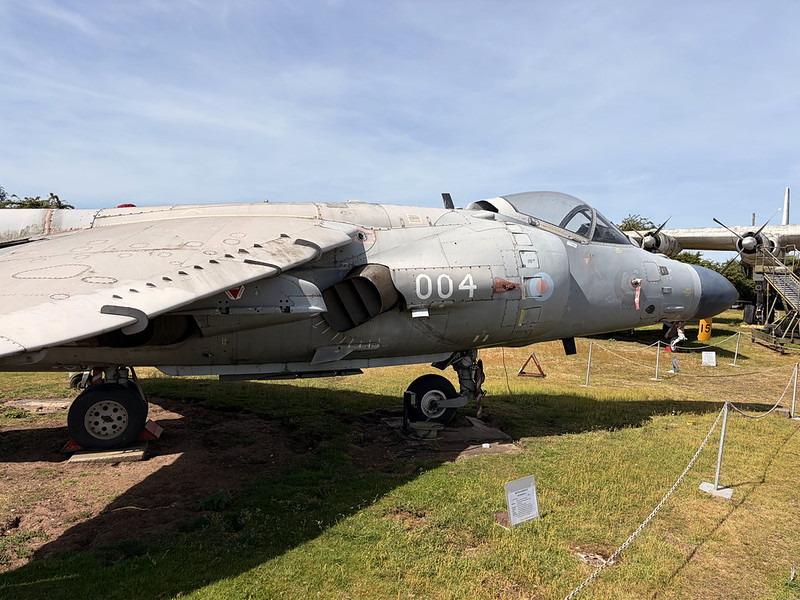
Another view of the Sea Harrier