
Baguley Cars was a builder of railway locomotives active from 1911 until their acquisition by Drewry Car in 1964. They built many petrol or paraffin fuelled locomotives along with diesel, two of which are featured here.
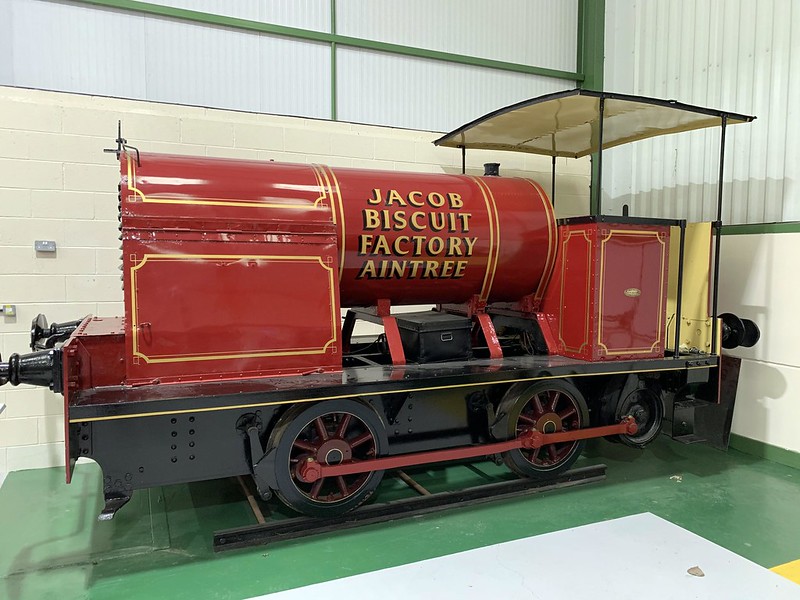
680 at the Statfold Barn Railway
| Information for 680 | |
|---|---|
| Number built: | 1 |
| Built: | 1916 |
| Builder: | Baguley Cars |
| Engine: | White & Poppe petrol/paraffin engine (later) Baguley 4-cyl petrol engine |
| Power: | 60 hp (45 kW) - original petrol 55 hp (41 kW) - paraffin 40 hp (30 kW) - later engine |
| Wheel arrangement: | 0-4-0PM |
Baguley Cars 680, now preserved at the Statfold Barn Railway, is probably the oldest surviving standard gauge petrol locomotive in the world [1]. Like many industrial locomotives it had a long working life of over fifty years. It was delivered new, as a petrol or paraffin fuelled locomotive, to Richard Johnson & Nephew's armaments factory (Ministry of Munitions National Filling Factory No. 2) in 1916. It moved to W & R Jacob's biscuit factory in Aintree after the war and remained there until retirement in 1967.
In 1927 it was hired out to the Cheshire Lines Committee to help with some civil engineering work. They managed to badly damage the locomotive and it had to be rebuilt. The original White & Poppe petrol/paraffin engine was replaced by a Baguley petrol engine which was less powerful but adequate for it's duties at the biscuit factory. No. 680 returned to work and remained in use for forty years as the spare locomotive on the company's internal network. No. 680 remained in service until the factory closed it's internal rail network in 1967 and was preserved. Since retirement 680 has spent time at the Beamish Open Air Museum before arriving at the Statfold Barn Museum in 2011.
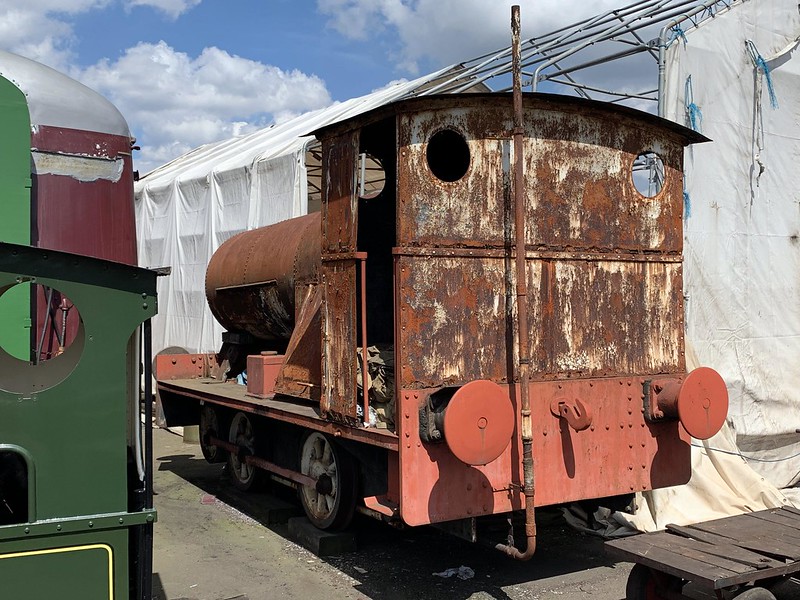
Baguley 800 at Tyseley
Baguley Cars 800 was built to order by McEwan Pratt & Co. for Dought Son & Richardson in 1920 (McEwan Pratt being a pseudonym for Baguley Cars). However, the locomotive was never delivered and instead remained at Baguley as a works locomotive until 1933. It was finally sold to the London Brick Company and remained in service with a number of owners until the mid-1960s until it entered preservation.
Baguley Cars 800 is similar in form to the earlier 680 from the same manufacturer though more powerful. The engine was located next to the cab, ahead of it was a large water tank used for coolant. This gave the locomotive an appearance similar to the steam engines it was intended to replace.
[1] C.R. Weaver, "A veteran retires", Industrial Railway Record No. 21 (IRS 1968) p. 305