
The Class 31 was the last surviving Type 2 diesel locomotive in National Rail service with a small number remaining in mainline service into the late 2010s. Originally they were known as the Class 30 and were amongst the earliest diesel locomotives to enter service with British Railways. The earliest mockup designs for the locomotive had just two windows on the cab ends with a look similar to the likes of the Class 21, but by the time construction had begun the design had been changed to have three windows due to the need to fit gangway doors [1].

D5581 as 97 205 preserved in pseudo-RTC livery, at Princes Risborough
| Information | |
|---|---|
| Number built: | 263 |
| Built: | 1957-62 |
| Builder: | Brush Traction |
| Engine: | Mirrlees JVS12T later changed to English Electric 12SVT diesel |
| Power: | 1, 470 hp (1, 100 kW) |
| Wheel arrangement: | A1A-A1A |
The Class 30's Mirrlees JVS12T engines gave British Railways a lot of trouble, the engines beginning to develop metal fatigue after just a few years service. It is thought that uprating the engines may have been to blame as the originally rated engines did not develop as many faults. The original pilot-scheme locomotives were rated at 1, 250hp but later production batch locomotives were uprated to 1, 365 hp and beyond. One was even uprated to 2, 000hp and became a Type 4!.

Although numbered 31 018 this was the first of the class built, preserved at the NRM
Eventually the decision was made to give the entire class more reliable English Electric powerplants instead in the mid-1960s [2] and they were re-classified the Class 31. The Class 31 has the unusual A1A-A1A wheel arrangement which means the middle axle in each bogie is unpowered.
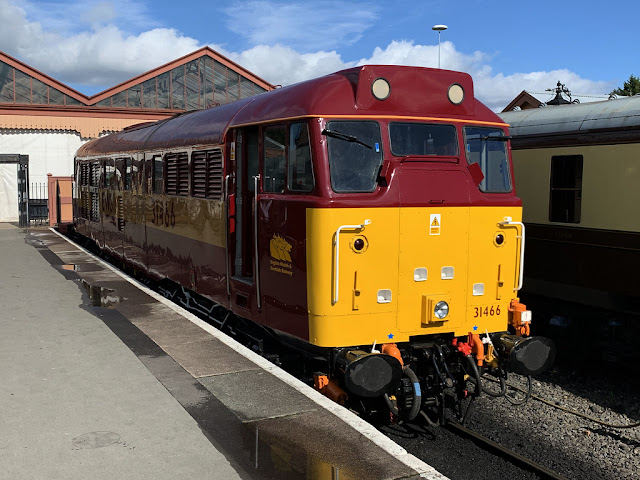
EWS liveried 31 466 at Kidderminster Town
As true mixed traffic locomotives Class 31s could be found on regional and secondary passenger services, freights and engineering trains and have survived into the privatised era. In their later years they were mainly seen on spot hires and engineering trains [3]. A few remaind mainline registered into the 2020s with around twenty-six having been preserved.

BR Blue 5580 at Kidderminster Town
| Sub-class | Details |
|---|---|
| 31/0 | Original pilot-scheme batch of twenty, non-standard control equipment |
| 31/1 | Main production variant |
| 31/4 | With Electric Train Heating (ETH) |
| 31/5 | Former 31/4s with ETH isolated |
| 31/6 | Wired for ETH but without equipment |

31 270 in Regional Railways livery at Rowsley South
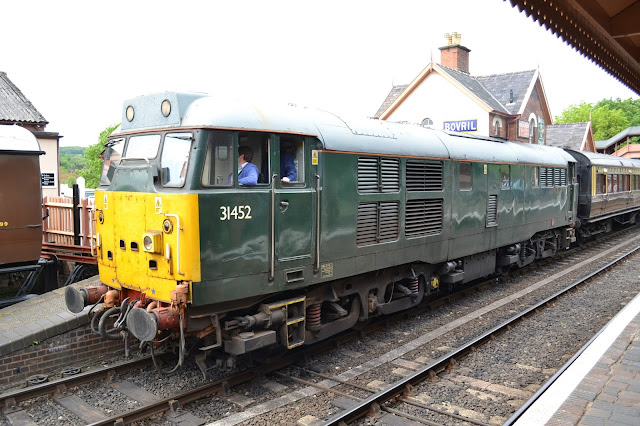
DCR 31 452 at Bewdley
[1] David Lawrence, British Rail Designed 1948-97 (Ian Allan, 2016) p. 124
[2] Brian Haresnape, Production Diesel-Electrics Types 1-3 (Ian Allan, 1983) p. 48
[3] Colin J Marsden, Traction Recognition (Second Edition) (Ian Allan, 2009) p. 20