
In the late 1960s, British Rail began to look into high speed trains in order to compete with road and air transport on long intercity routes. Although BR would have loved to have been able to construct entirely new routes such as in France and Japan which were not constrained by the legacy of Victorian planning and loading gauge, they knew there would not be the funding available for this and so instead looked into how to produce high speed trains that could run on existing BR rails. One way to increase speeds was thought to be a tilting train that could handle curves much faster and more comfortably than existing stock and the Advanced Passenger Train - Experimental (APT-E) was built to help develop and test tilting technology [1].
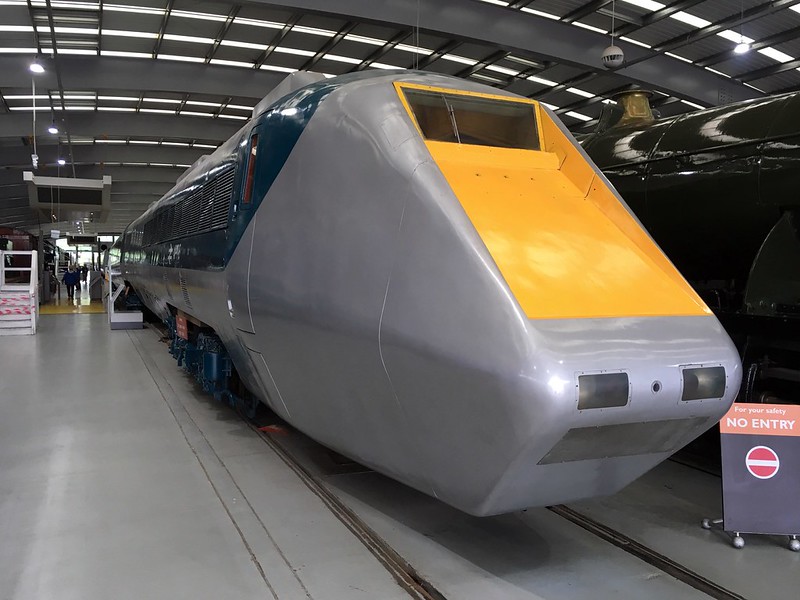
APT-E power car at NRM Shildon
| Information | |
|---|---|
| Number built: | 4 (1 4-car set) |
| Built: | 1972 |
| Builder: | Metro-Cammell / BR Derby |
| Engine: | 8 Leyland 350 gas turbines |
| Power: | 2, 384 hp (1, 778 kW) |
Gas turbines were chosen for the APT-E in order to produce the desired power-to-weight ratio (it was decided not to produce an electric APT-E as this would be restricted as to the routes it could be tested on) [2]. The early design of the APT-E owned more to aeronautical than railway practice but in the end a faceted wedge was chosen for the shape of APT-E [3].
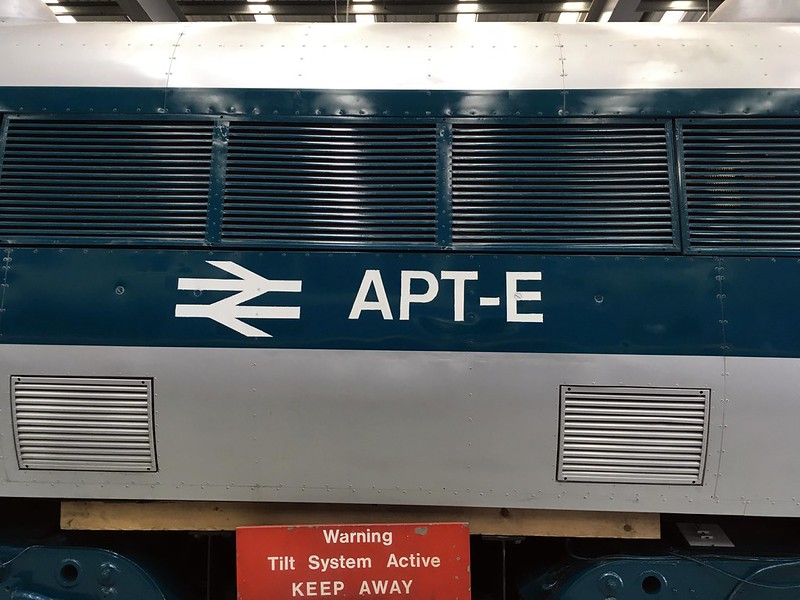
APT-E and BR logo, the unit had a non standard blue and silver livery
The bodies of APT-E, twp power cars and two trailers were built by Metro-Cammell, the cars had a light weight construction from sheet aluminium. They were married to articulated bogies which were designed to improve ride at speed by "part-steering" the train through curves [4]. One trailer was filled with test equipment, with the other having some seating to test passenger experience in a tilting train, however it was never used in revenue earning service.
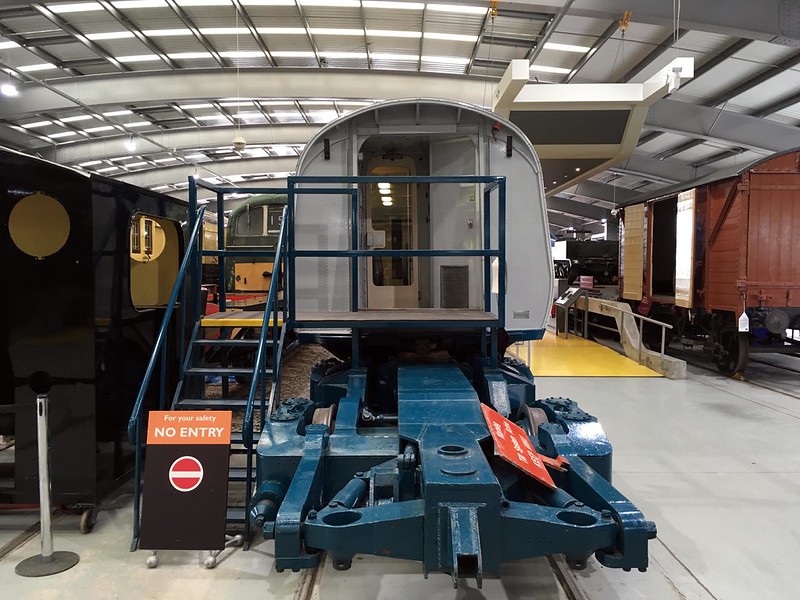
View of the car profile and articulated bogie
The APT-E began operations in 1973 (delayed by industrial action) and ran until 1976 which it was withdrawn from service (the high cost of gas turbines contributing to the decision), the unit was later preserved at the National Railway Museum. In its time it reached 152.3mp/h [5], then a new British railways speed record. The APT-E was followed by the electric powered Class 370 APT-P which was hoped to be the future of the British Rail intercity fleet. Ultimately, the project failed, however tilting technology was later used in trains that run down the WCML and ECML to this very day.
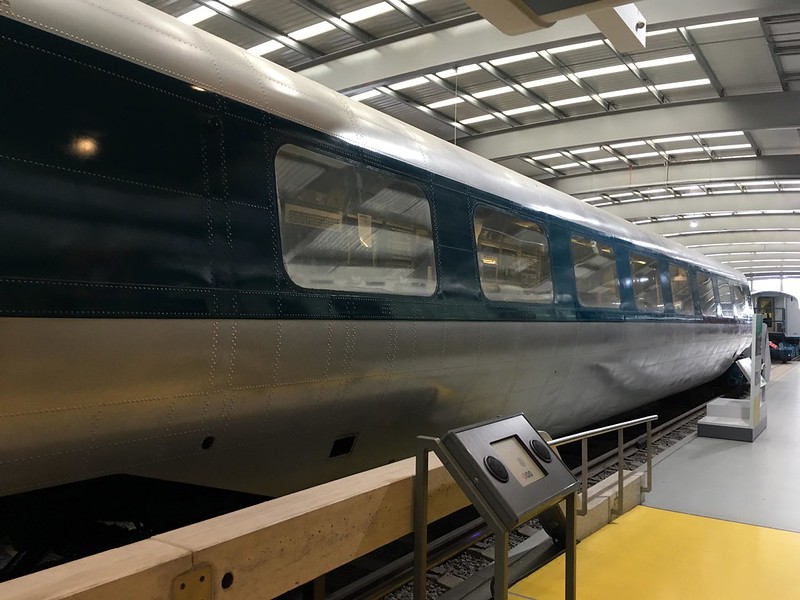
Side view
Interestingly, parts of the APT-E project grew out of the High Speed Freight Vehicle (HSFV 1) project in the early 1960s, the fruits of which included the underframe and suspension of the Class 140 Pacer railbus!
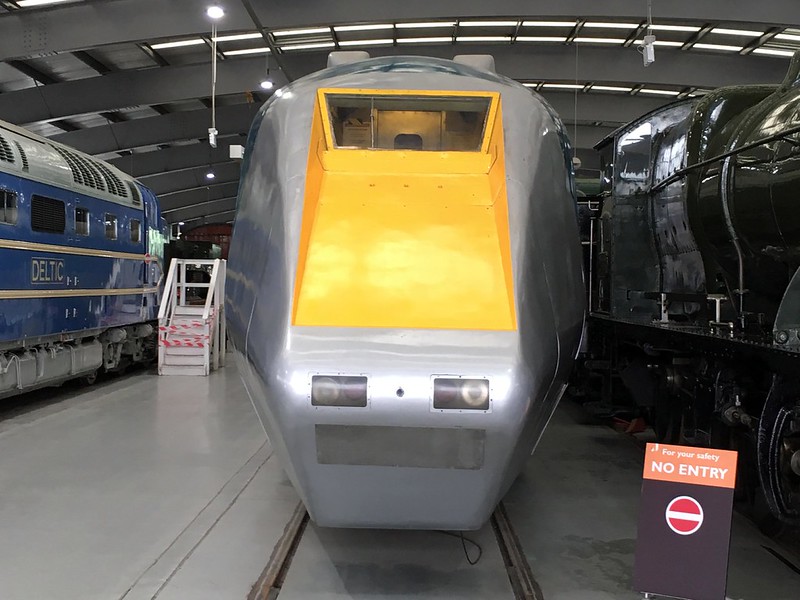
Business end
[1] Colin J. Marsden, 25 Years of Railway Research (OPC, 1989) p. 30
[2] Ibid. p. 31
[3] David Lawrence, British Rail Designed 1948-97 (Ian Allan, 2016) p. 188
[4] Brian Haresnape, High Speed Trains (Ian Allan, 1983) p. 34
[5] Marsden, p. 33