
The original batch of 4-car electric multiple units, originally known as the Southend Augmentation Stock, the AM8 (later Class 308/1) was built for commuter services out of London Liverpool Street to Colchester, Clacton and Walton [1].
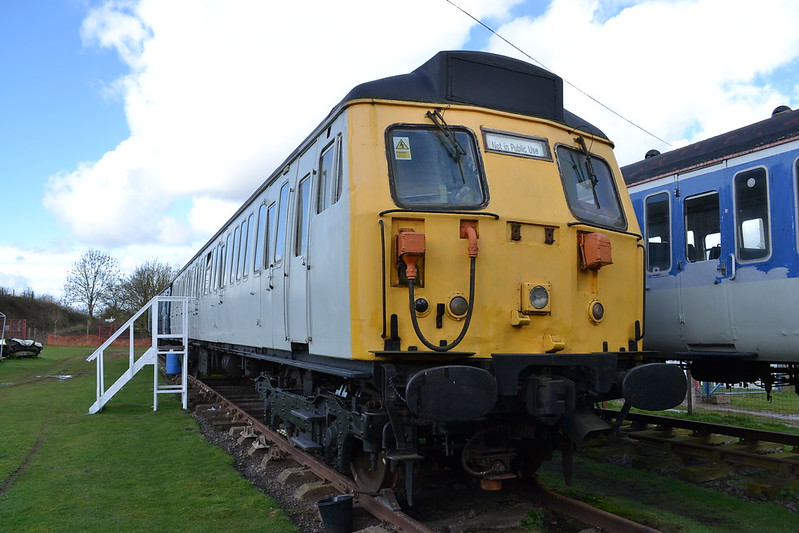
Preserved 308, at the time it was at the now closed Electric Railway Museum
| Information | |
|---|---|
| Number built: | 177 (45 3 and 4-car sets) |
| Built: | 1959-61 |
| Builder: | BR York |
| Engine: | 4 EE 536A traction motors per set (25kV AC OHLE) |
| Power: | 770 hp (574 kW) |
| Formations: | 308/1 : Battery Driving Trailer Composite Open Lavatory (BDTCOL)+Motor Brake Standard Open (MBSO)+Trailer Standard Open Lavatory (TSOL)+Driving Trailer Standard Open (DTSO) 308/2 : Battery Driving Trailer Standard (BDTS)+Motor Luggage Van (MLV)+Trailer Composite (TC)+Driving Trailer Standard (DTS) 308/3 : BDTS+Motor Brake Standard (MBS)+DTS 308/4 : BDTS+MLV+DTS |
Later on they were joined by a second batch (308/2) for boat train services out to Tilbury from London Fenchurch Street. One car was dedicated as a luggage van (though could also stow cycles and other items - it even included a fish stowage area!) [2] Finally a batch of 3-car units (308/2) was built for services from London Liverpool Street to Chingford and Enfield Town. Externally the Class 308 looked similar to the likes of the Class 305 and 504 EMUs and had similiar equipment to the Class 302.
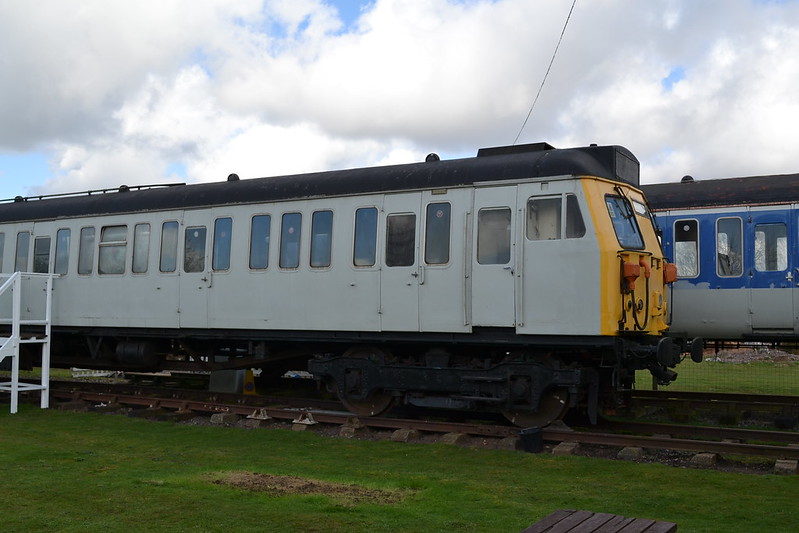
Another view of the preserved DTSO
In the early 1980s the Tilbury boat trains ceased after Tilbury closed as a cruise liner terminal. Three Class 308/2s were rebuilt as 308/4 postal trains, the non-motorised trailer being removed to make them 3-car units. Withdrawals of the 308 began in earnest in the late 1980s with the 308/2s and 308/3s being withdrawn. The 308/1s survived into the privatised era however and in their final years spread further afield. They could be found in the West Midlands (the first units on the Cross-City Line after electrification) and North East as a stop-gap stock pending new build EMUs [3]. They were finally withdrawn from service in 2001. One 308/1 DTSO has been preserved.
[1] Colin J. Marsden, Motive Power Recognition 2: EMUs (Ian Allan, 1982) p. 28
[2] Alec Swain, Overhead Line Electric Multiple Units (Ian Allan, 1990) p. 44
[3] Colin J. Marsden, DMU and EMU Recognition Guide (Ian Allan, 2013) p. 225