
The Sopwith Pup entered service mid-way throughout the First World War. Although a good all-round aircraft, by the latter stages of the war it was already becoming outclassed due to the rapid nature of warplane development.
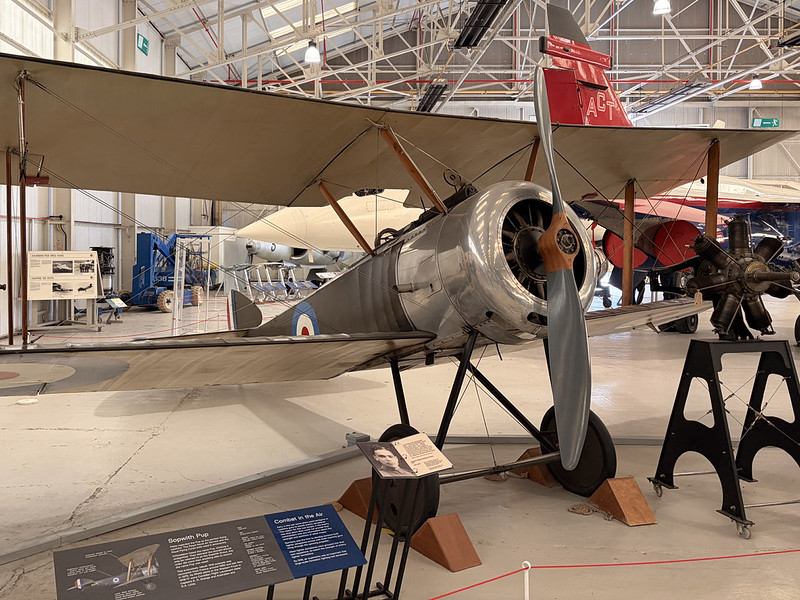
N5182 at RAF Museum Cosford
| Information | |
|---|---|
| Manufacturer: | Sopwith Aviation Company |
| First flight: | 1916 |
| Propulsion: | Le Rhône 9C 9-cylinder rotary piston-engine |
| Withdrawn: | 1918 |
| Number built: | 1,796 |
The Sopwith Pup grew out of a test aircraft produced in 1915 for the test pilot Harry Hawker. Interestingly, the official name of the aircraft was the Scout, but pilots called it the Pup as it was like a smaller version (or pup) of the Sopwith 1½ Strutter. The Admiralty were unamused but the Pup name stuck even though it was never official. The Pup first appeared in early 1916 and was a biplane with equal-span staggered wings. It was powered by an 80hp radial engine and armed with a Vickers machine gun. Both the Royal Naval Air Service and Royal Flying Corps placed large orders for the Pup which entered service in October 1916.
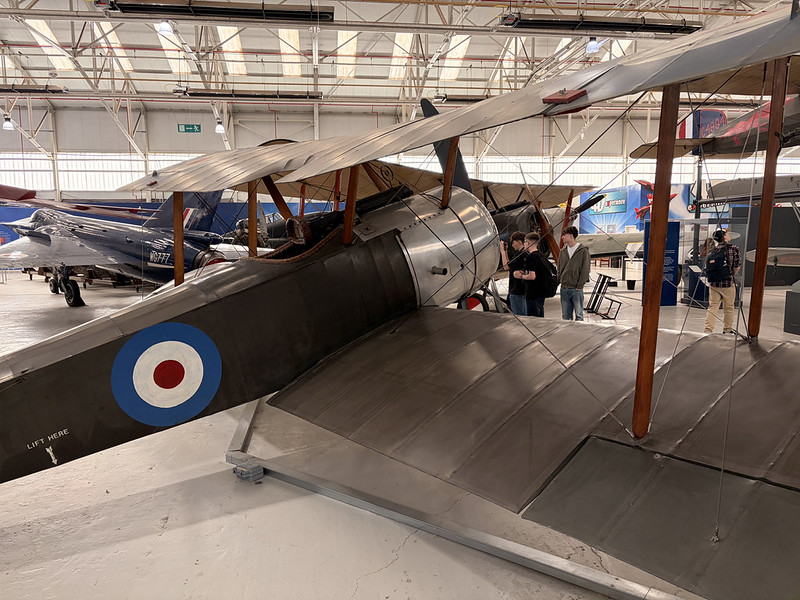
Another view of N5182
The Pup was a simple lightweight aircraft with a good rate of climb and was highly manoeuvrable. It was an immediate success on the Western Front, outclassing the Fokkers and Albatros biplanes then fielded by the Germans. However, within a few months a new generation of German planes had regained the upper hand. Pups remained in front-line service until the end of 1917 despite suffering progressively heavier losses. The Pup continued to serve in Home Defence units to combat the new threat of Gotha bombers. These Pups were later fitted with more powerful engines.
A Sopwith Pup, on the 2nd of August 1917, became the first aircraft to successfully land on a moving ship. The Pup later served on a number of Royal Navy aircraft carriers and other ships. The Pup also served in the training role until just past the end of the war. After the war, small numbers were supplied to Australia, Greece, Russia and the United States.