
Once aeroplanes started to be used by militaries in the First World War, there was the need to fight other aeroplanes. The problem of firing through the propeller was a tricky one to solve at first (as shooting off your own prop wouldn't be very good for performance). The first custom built fighter aircraft, the Vickers FB5, placed the propeller behind the gun (and crew).
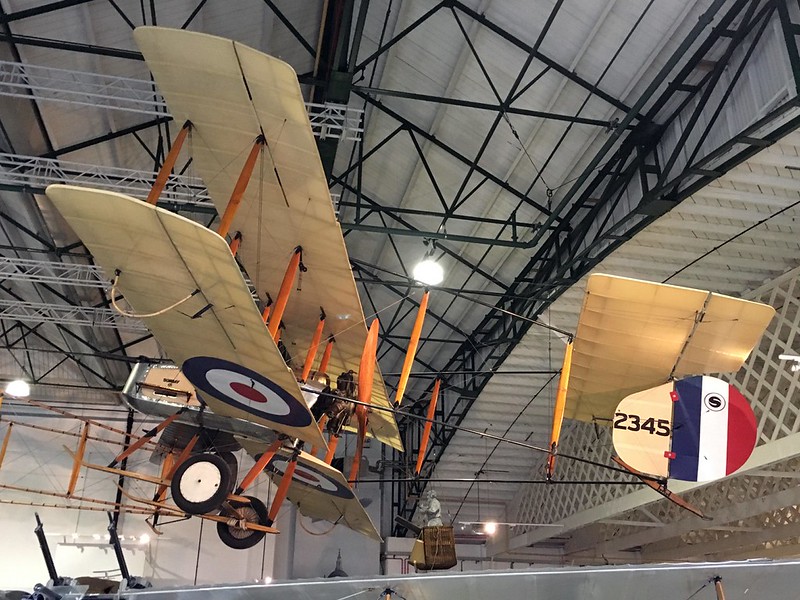
2345 is a replica FB5, seen at at RAF Museum London
| Information | |
|---|---|
| Manufacturer: | Vickers Limited |
| First flight: | 1914 |
| Propulsion: | Gnome Monosoupape rotary piston-engine |
| Withdrawn: | 1916 |
| Number built: | 207 |
Vickers began working on a fighter aeroplane as early as 1912, the FB5 (Fighting Biplane 5) grew out of earlier designs and first flew just before the start of the war. The FB5 had a pusher propeller with an observer in front of the pilot armed with a Lewis machine gun.
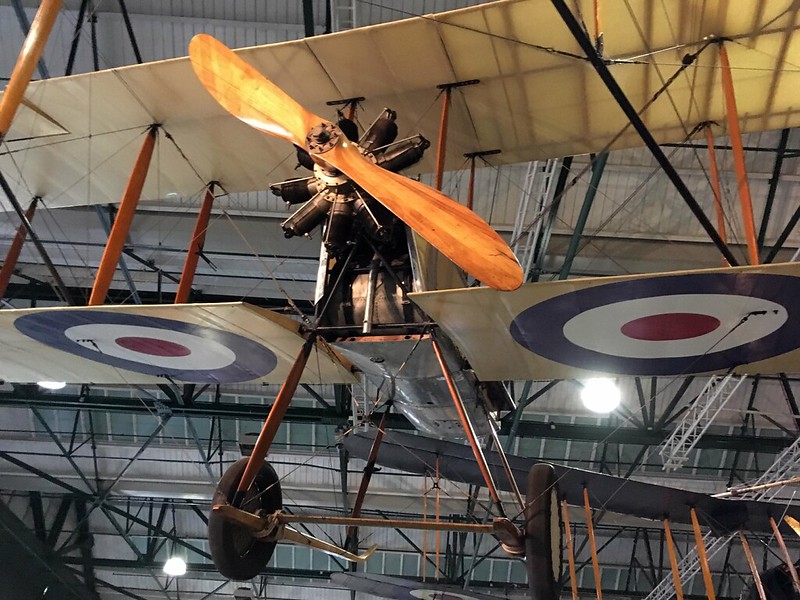
Rear view of 2345
The FB5 entered service in November 1914, the first air-to-air combat taking place on Christmas Day, the German plane may have been shot down but it is unconfirmed. The first fighters squadrons armed with FB5s were deployed on the Western Front in 1915. As a concept the FB5 worked well, though was rather slow and many German opponents were simply able to outrun the FB5 and escape. The FB5 quickly became obsolete as a new generation of fighters arrived on the scene and was withdrawn in 1916. The Danish Air Force continued to operate a small nunber until 1924.
A later development of the FB5 was the FB9, which had a more refined streamlined fuselage and an improved gun placement.